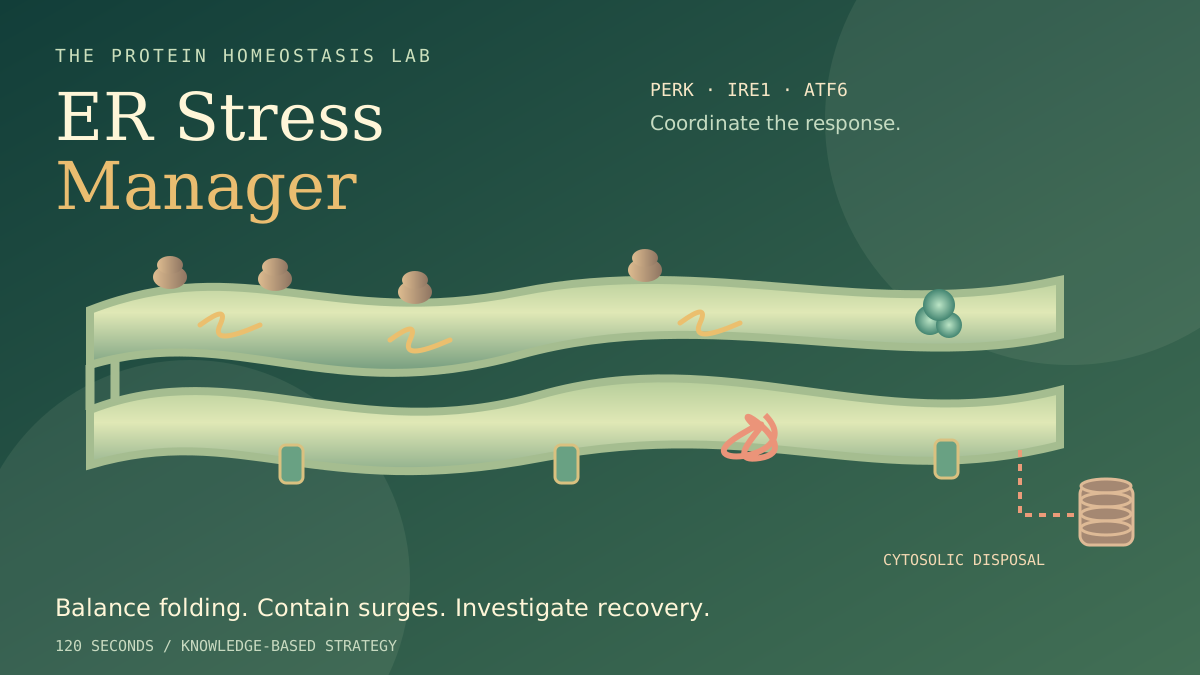
Gold loops: recoverable clients · red tangles: authored persistent substrates · green clusters: folded cargo. Symbols represent pools, not individually measured molecules.
Handling pressure0%
Prepare your response.
Branch-selective experimental activation in an engineered teaching model. One focus lasts 14 playing seconds; switching has a 3-second controller reset. These are game abstractions. Capacity develops gradually; other endogenous branches remain active.
Select a response suited to the bottleneck; balance input, folding and disposal.
Interventions are authored experimental configurations. Increasing expression does not instantly create effective machinery; delays, capacities and rates are illustrative.
SEPARATE OBSERVATIONS / SYNTHETIC UNITS
— Gold: folding backlog– – Red: persistent ER burdenTime: active playing seconds
Selected pathway outputs
A low reporter alone does not prove recovery. Burden, useful export and viability are separate observations. No biological dose, duration or death threshold is claimed.
UNTIMED / EVIDENCE AND APOPTOSIS INVESTIGATION
What did the system recover?
Compare matched experimental controls
The two reference runs below are precomputed synthetic controls. Both use normal reporter expression, baseline manual support, identical starting conditions and the same load through 90 seconds. Only withdrawal of the external load differs after 90 seconds. Automatic UPR adaptation remains present in both. The player run may differ in several interventions, so it is not a single-factor causal test.
Separate populations: recovery and apoptosis
These authored populations are independent of your game outcome. Rows are separate experimental follow-up points, not playing seconds. All values are normalized illustrative units; mitochondrial signaling denotes an authored MOMP-associated readout.
Select the observations supporting apoptosis in the persistent-stress population:
✳
For the curious at heart. A pocket-sized collection of science-inspired games. Made for a quick break, a little discovery, and one more round.
DESKTOP / TABLET / MOBILE Your browser is your playground.