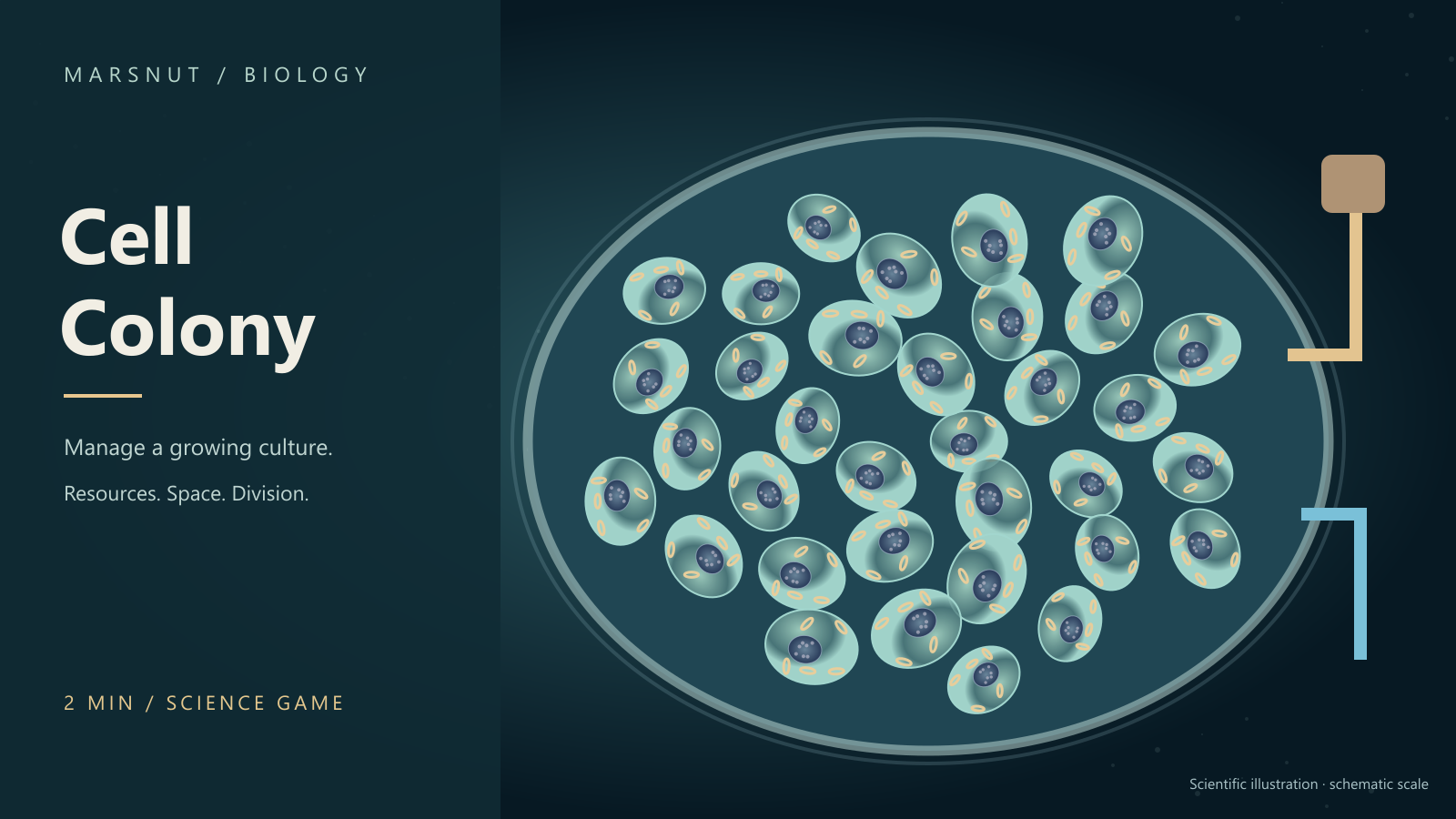
One dish. A growing population. Keep nutrients and oxygen available, expand the culture area, and decide when growth should slow before the colony exhausts its resources.
2 MINUTES · POINTER / TOUCH / KEYBOARD · OFFLINE READYBest round: —
Population and resource values are model indices. Conditions and culture rates are not a laboratory protocol.
Your observations will appear here.
A growing population increases resource demand. Many cultured animal cells respond to growth signals and density; resource depletion and waste can also limit proliferation. Resting cells still require maintenance resources.
Further reading, available when online:Extracellular Control of Cell Division and GrowthThe Eukaryotic Cell Cycle
For the curious at heart. A pocket-sized collection of science-inspired games.Made for a quick break, a little discovery, and one more round.
Manage a hypothetical aerobic, density-sensitive animal-cell culture for two minutes. Practice mode removes the deadline and continues to simulate the selected culture.
Passaging retains 80% of the cultured population and removes some waste. Transferred-away cells are not counted as deaths. Expansion stops at 130 space units.
Keyboard: Q exchanges medium, W adds oxygen, E clears waste, R expands, T passages, A installs a pump, S installs an aerator. 1–3 set division stimulation; P pauses; M toggles music; H opens help.
Cell counts, thresholds, credits, rates, and disturbances are game mechanics, not culture protocols or biological predictions. Oxygen requirements vary across cell types. Density-sensitive proliferation has several mechanisms; physical contact alone does not explain all growth inhibition.
Music starts after a play action. Help, pause, and a hidden browser tab freeze the round. A saved best score stays on this browser when storage is available.